Lulworth cove
This Amazing world heratige site is one of the most stunning sites on the south coast of england. This beautiful place atracts many visitors each year and is close by to Durdle door and stair hole, both aswell stunning visits.
But there is an increasing amount of worry about the number of visitors each year coming to visit Lulworth and the problems being caused by this both the Geological and Social. This site's aim is to help raise awarnedd of the issues casue by torisim and put in place ways to make Lulworth and its surounding areas much more sustainable
Lulworth Cove & CrumpleLocation: Lulworth The geology in detail The rock layers on this part of the coast have been folded so that the layers appear almost vertical. Hard Portland and Purbeck Stone forms the cliffs with much softer Wealdon Clay, Gault and Greensand behind with the chalk forming the back of the cove. This is an internationally renowned place for the study of different rates of erosion in the formation of bayes and headlands. Below is a brief description of these various rock sequences. Portland Stone - Oolitic limestone that formed at the end of the Jurassic in warm shallow water very much like the Bahamas. Purbeck Stone- A series of thin layers of limestone and clay that formed in swamps. Wealdon Clay - Clay and sandstone layers that were layed down in rivers flowing from the west (the sandstone layers contain quartz grains eroded from Dartmoor Granite over 120 million years ago) Gault- A soft clay formed in a still marine environment. It is rarely exposed well because it is so soft. Greensand- Generally quite soft sandstone containing the green mineral glauconte. It formed in a shallow sea and often contins abundant trace fossils (burrows) Chalk- An almost pure limestone that formed at the end of the Cretaceous in a warm 200 - 300m deep sea. It is made up almost entirely of the microscopic skeletons of plankton. The formation of the Cove The attractive form of Lulworth Cove formed due to the effect of the erosive power of the sea on the vertical layers of different types of rock. At some point in the past the river would have punched a hole in the hard Portland Limestone that formed the cliffs. Once the sea could breach those rocks it quickly eroded the much softer rocks behind, widening the gap and creating the rounded cove. This process has happened in several places along the coast here and is still happening. At Man‘O War Cove to the west two old coves have been eroded to form one with only a string of reefs showing where the Portland Stone once was. And Stair Hole just next to Lulworth is a new cove in the making. Eventually it will join up with Lulworth Cove. | 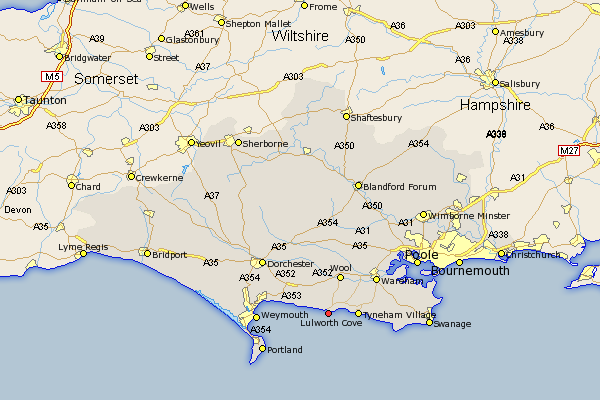 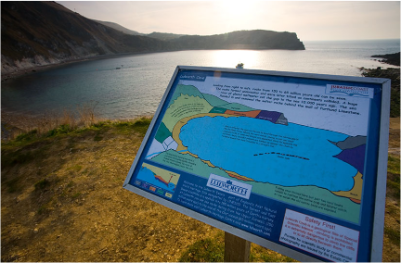 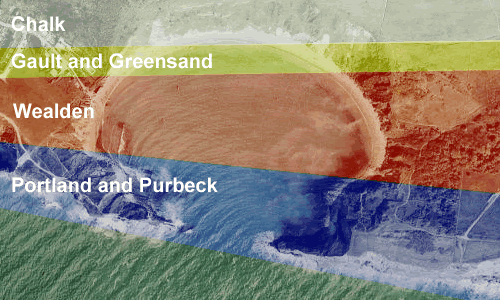 |
